Reviews of The Frankenstein of 1790 and other Lost Chapters from Revolutionary France

Douthwaite_J_Frankenstein_
The reviews are starting to arrive!
- David Coward’s review was published as “The March of the Women” in the the Times Literary Supplement (London) on May 10, 2013.
- Daniel Sullivan‘s review was published in the Ernest Becker Foundation April 10, 2013 newsletter, here.
- Allan Pasco‘s review came out in the February 2013 Choice.

Doonesbury and Marat

2012 David Maratdoonesbury and marat db130421
This article picks up where the discussion on Go Comics and other sites left off: with an informed linkage to the revolutionary original.

Trudeau’s cartoon strip memorializes his hero just as David did with his 1793 portrait. Subtle differences reveal a less glorious message however: where David put an enigmatic smile on Marat’s death mask to reveal his serenity and wisdom, Trudeau’s hero Razil is portrayed with the gaping stupor of an idiot. Like Razil, Marat wrote quickly, did little research to back up his views, and subsequently few if any of his writings are worthy of reading today. The only reason Marat lives on is David’s masterful portrait and its mysterious aura. Razil will not fare so well; the dopey expression Trudeau inscribed on his face says it all.

The French aristocracy today, according to Anna Gavalda and Albin de la Simone. Facile satire or signs of an authentic paradigm-shift?

albin_de_la_simone_03Albin de la Simone, “Mes épaules”
Anna-Gavalda-Ensemble-c-est-tout
Two popular artists are dealing an interesting curve-ball to the hidebound prestige of the French aristocracy today, although the ultimate meaning of their works remains ambiguous…

1. Anna Gavalda

Q: Where can you find a living, breathing counter-Revolutionary from the Vendée today?
A: In Anna Gavalda’s novel, Ensemble, c’est tout.
His name is Philbert Jehan Louis-Marie Georges Marquet de la Durbellière ; he was born in 1967 in La Roche-sur-Yon, and as a child, he fought off bullies by swinging a satchel armed with a Latin dictionary.

Gavalda must have had a good time inventing his quaint speech patterns for this book! When he finally gets over his stuttering enough to introduce himself to the down-on-her-luck heroine, he explains: “Vous avez devant les yeux un magnifique exemplaire d’Homo Dégénéraris, c’est-à-dire un être totalement inapte à la vie en société, décalé, saugrenu et parfaitement anachronique!” (163). It is thanks to his family’s cavernous apartment on avenue Émile Deschanel (one of the capital’s most prestigious addresses, bordering the Champs de Mars, Paris 7e), that the group of oddballs joins forces in this delightful saga of three misfits who find each other and, against all the odds, form a lasting, loving, “recomposed family.”

Philibert is a caricature of hilariously outmoded habits. When the trio writes up a list of rules for the household, he pulls out a signet and stick of wax, and seals the document with his family’s arms. He is hopelessly incapable of battling it out in the rough-and-tumble capitalism of the twenty-first century, and makes a paltry living by selling postcards of Paris monuments on the street. The history lessons he conducts on their road trips are peppered with deadpan asides on his family’s ties to the French throne (Marguerite de Valois being one of his mom’s cousins). The rest of the Marquet de la Durbellière clan is equally ridiculous; the dead fauna hanging on their walls brings images of The Adams Family to mind, but it is a cold, dusty kind of Gothic here without a touch of humor or gore. Their outdated speech habits (le vouvoiement oblige) and austere home life underline the aristocracy’s inability to evolve, as does their soul-less Catholicism. (The Easter blessing of “Bénissez-nous Seigneur… et bla bla bla” being symptomatic! 545) The author stresses their impervious blindness to economic realities at a boorish banquet at which the marquis and his wife lord it over their son’s friends while serving tasteless canned peas on dishes of priceless china, accompanied by elegant crystal glasses of cheap wine. Baffled by the presence of these lowbrow strangers, the marquise trills, “Comme c’est pittoresque” (541), as if her son was indulging in a bit of Belle époque encanaillement (hobnobbing with the rabble).

The weekend would have been ruined, if Franck (the foul-mouthed, talented cook who is Philou’s best friend from Paris) hadn’t taken charge of the kitchen and whipped up a fabulous Easter dinner, inciting the marquis to share some exquisite bottles of his uncle’s wine, and to get a little drunk and tell funny old stories of his hunting days. On the return trip to Paris, Philou suddenly recalls the reason why he had wanted to visit home: his engagement to a girl from the working-class neighborhood of Belleville, and which he forgot to mention. Significantly, they do not turn the car around. Nor do any members of the Marquet de la Durbellière tribe attend the sweet nuptials, celebrated in the Town Hall of the 20th arrondissement.

2. Albin de la Simone
A similar melancholy about the emptiness of the aristocracy haunts a song that is popular among French youth today, by Albin de la Simone, “Mes épaules.” Ostensibly a love ballad by a young father to his wife and baby, where anxiety over the role of breadwinner is symbolized by his skinny shoulders (“pas bien baraquées,” he swoons), the song also belies the singer’s unease with his particule-laden family name. “Le poids de mon nom ridicule / De ce fantôme à particule / Qui avance quand je recule,” the song goes. Typifying a particularly French strain of wimpy male singers whose penchant for self-pity surprises American audiences (remember Alain Souchon’s hit “Allô Papa Maman”?!), Albin de la Simone is nevertheless a favorite among young Frenchmen today, according to reliable sources in Paris. What is interesting is how he combines his worries over fatherhood with his sense of embarrassment over his aristocratic name.

Could it be that France is finally breaking free from the class-bound system of the past? Is Bourdieu’s paradigm in Distinction really due for a tune-up?

Or are these recent phenomena merely a pose, like the long tradition of rueful yet self-congratulatory writers who make up the French canon?

Update on ‘Babette’s Feast’: A Parable of French Politics and Cookery from the Age of Revolutions

Babette's FeastBabette book cover DanishAs an epicurian (married to a chef-de-cuisine, how could I not be in love with food?) “Babette’s Feast” continues to haunt my thoughts. And now, with some recent discoveries, I am more convinced than ever of its debt to revolution. And the need for a remake!
A few thoughts on my discoveries, to intrigue you:

- On the feisty spirit that emerges in Danish!
Thanks to the great book by Frantz Leander Hansen, The Aristocratic Universe of Karen Blixen (2003), nowadays a more bracing and sober accounting is available to English-language readers. Hansen proves that Dinesen, in rewriting the tale for Danish audiences, reinforced the revolutionary tone and threatening aspect of her heroine. Fantastic linguistic analysis! Thanks FLH!*

- On “Babette’s” Sympathy to La Commune and its Ideals
The 2003 translation of the 1891 history of La Commune by Isak Dinesen’s father, Wilhelm Dinesen Paris sous la Commune, Translated from the Danish by Denise Bernard-Folliot, provides the historical subtext that was hugely important to Dinesen: a fact that has been ignored by most readers. WD was very sympathetic to the ideals of La Commune, and this book should be a “must” for anyone seeking a thoughtful eye-witness account of the terrible events. Thanks DBF!

- Third, tucked in the stacks of Hesburgh Library at ND, I found a copy of the 1952 Danish translation by Jørgen Claudi with the fabulous cover illustration featured here. This rendition makes a startling contrast with the tasteful and cleaned-up rendition presented by Gabriel Axel, no?

In my work-in-progress, these elements are juxtaposed to the film and show how much stronger and more menacing the heroine is in the original text (especially in Dinesen’s Danish version). Dinesen’s character does not forget the past or the utopian hopes she once harbored for La Commune. Rather she transforms them into the ultimate beau geste of a consummate artist and an unrepentant radical. For the last supper of Babette’s Feast is not a liturgical rewriting of silent sacrifice but rather a sadly misunderstood celebration of a lost era. However no one realizes it except Babette. (And her new readers today!)

Hope you enjoyed this little taste of work-in-progress. More to come… jd
(updated 3/15/13)

* Thanks are also due to Lise Kure-Jensen who notes that one of the interesting challenges of studying the work of Isak Dinesen is that, after writing her stories in English, she translated many of them back into Danish (her native tongue) and made significant changes along the way. Most notably, she made the Danish translation of “Babette” WILDER! See LKJ, “Isak Dinesen in English, Danish, and Translation: Are We Reading the Same Text?” in Isak Dinesen: Critical Views, ed. Olga Anastasia Pelensky (Athens: Ohio University Press, 1993), pp. 314-321.

Montillo on Frankenstein: a partial origin tale

A review today in the New York Times brings a new book to the attention of Frankenstein fans: The Lady and her Monsters by Roseanne Montillo. Sounds like the book covers the basics: the science, the hubris, the sense of treading where no man has gone before. Too bad she neglected the French origins!

Marie-Antoinette action figure and Call for other objets d’art of revolutionary culture

Marie-Antoinette action figureIn honor of a fascinating art exhibit opening soon at the Musée de la Révolution française (see below), I would like to share my personal favorite French Revolution toy: the Marie-Antoinette action figure! First found in the Archie McPhee store in Seattle, this edifying little objet d’art is now available via multiple vendors on the internet. An authentic version should feature: 1) the ejectable head with its detachable wig; 2) the two costumes of the queen: regal robes and a fetching peasant outfit.

My friends, students, and family have so enjoyed playing with our Marie-Antoinette that her plastic head socket has gotten a bit out of joint. Thus my question: how, oh how, will I ever get the queen’s head back on her shoulders?!

An announcement : The volume, Les Mythologies révolutionnaires : la Révolution française dans les cultures et imaginaires populaires aujourd’hui, ed. Martial Poirson, is forthcoming, Éditions Garnier !
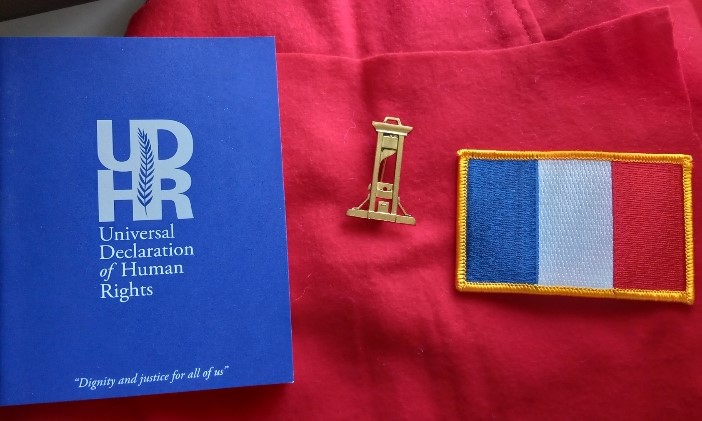
A query: An exhibit will be hosted at the Musée de la Révolution française in 2013-14 on the topic of « Popular Culture and the French Revolution Today, » organized by Martial Poirson and Museum Director Alain Chevalier (from June 2013 to April 2014). The organizers seek suggestions of objects from popular culture to include in the gallery, for example, novels or popular fiction, school books, images, caricatures, photographs, and any kinds of objects or accessories dating from the last 20 years. Do you have any suggestions on “Musts” of the French Revolution? If so, let us know (we would love to share your findings with the readers of this site) and/or write directly to Martial Poirson.

Version française
Une annonce : Le volume, Les Mythologies révolutionnaires : la Révolution française dans les cultures et imaginaires populaires aujourd’hui sous la direction de Martial Poirson est désormais à paraître aux éditions Garnier !
Une question, un appel aux contributions : Il y aura une exposition au Musée de la Révolution française sous la direction de Martial Poirson et Alain Chevalier, consacrée à “Cultures populaires et Révolution française aujourd’hui”, qui se tiendra à Vizille de juin 2013 à avril 2014. Dans un tel cadre, les organisateurs sont à la recherche de romans populaires, manuels scolaires (moins pour la qualité du récit ou de l’analyse que pour l’objet livre ou de la culture graphique), images, caricatures, photos, objets, accessoires, produits dérivés (des vingt dernières années uniquement), qu’ils pourraient exposer dans différentes vitrines et sur les murs.
Auriez-vous des suggestions “incontournables” ? Faites-nous savoir (nous aimerions bien l’afficher ici pour les lecteurs de « A Revolution in Fiction ») et/ou contactez Martial Poirson.

On Hooper’s Les Misérables, or the importance of not being too earnest

Harry Baur in Les Miserables

What can you say about a film that you hoped to like but didn’t? That it was schmaltzy and sincere? That it had nice horses and a pretty heroine? Or should you admit that it made you want to move to the back to the multiplex and cast your eyes down, out of compassion for the actors’ dignity?

The one thing I learned from sitting through Tom Hooper’s 2012 remake of Hugo’s 1862 novel, is that earnestness can be overdone. Sincerity fascinates, but only when it motivates action toward an admirable end, such as, say, bringing justice against people who commit war crimes. But sincerity for its own sake is, well, embarrassing.

Watching Les Misérables, I felt like a stranger who stumbled into a school play in a rich neighborhood. The sets were gorgeous (if unFrench), the costumes were well-made (check out the stitching!), and the actors had shiny white teeth and good haircuts (even Fantine’s Pixie looked cute). The only problem was, the actors are not my relatives, and I do not care how hard they were trying. Plus, they kept looking at me! Every view was a close-up of those poor actors whose lips, dental work, and nose hair were available for scrutiny. Not to mention their poor voices, quite clearly strained by the demanding score. What was Hooper thinking?! (More to the point, what was Russell Crowe thinking?!)

While waiting for the show to be over, I did make one significant discovery, however: Eddie Redmayne bears an uncanny resemblance to Jerry Mathers, star of the 1950s sitcom, Leave it to Beaver! It was their sincerity that gave it away. But wait, Beaver’s freckle-faced goodness was imbued with an impish sense of humor. And some episodes of Leave it to Beaver were truly suspenseful. (Who can forget when Beaver was stranded in that giant Teacup!) Sorry about that, Jerry.

"Hick" Portraits - 2011 Toronto Film FestivalJerry Mathers

But I’m mostly sorry for those of you who’ve actually read and love Les Misérables. Instead of heading to the multiplex, I suggest you check out Raymond Bernard’s 1934 version, with a stunning Jean Valjean played at his earthiest best by Harry Baur. (Available in the Criterion collection). Who needs a remake with this film on hand?

Follow

Get every new post delivered to your Inbox.